BIOARCHEOLOGICAL APPROACHES TO FEMALE TOBACCO CONSUMPTION
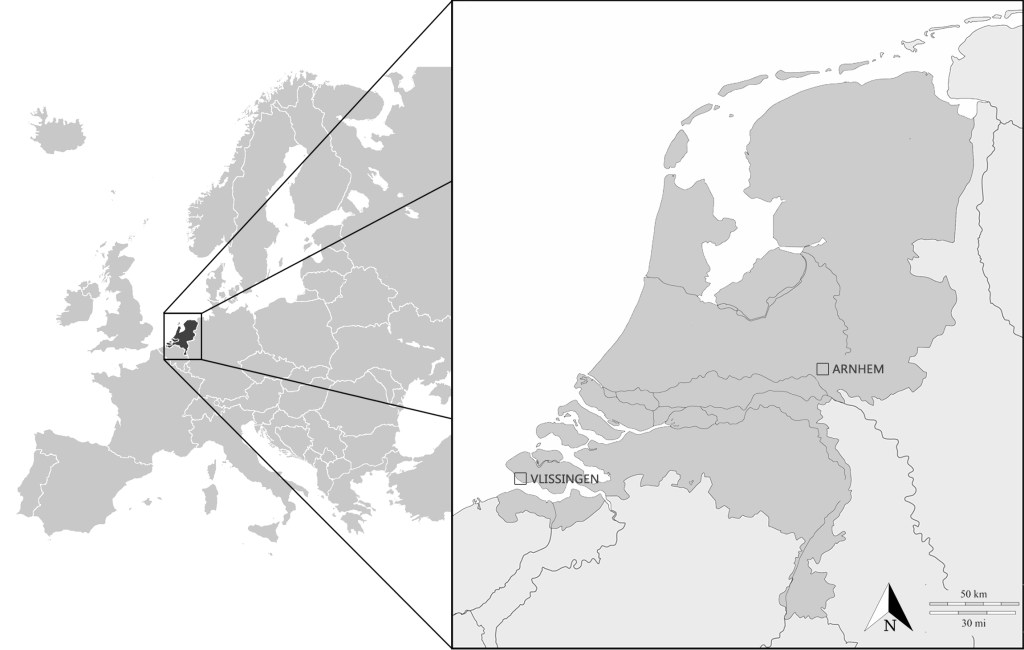
Location of the sites under study.
Arnhem (1330-1829 CE)
The skeletal assemblage of Arnhem was excavated in 2017 in the courtyard of St. Eusebius’ Church and comprises approximately 350 skeletons of mixed sex and age-at-death.
Relative and absolute dating of the graves were performed by Zielman and Baetsen (2020) using C14 dating and a Harris Matrix and a 3D model.
Each skeleton was attributed a dating range corresponding to two time windows: 1330-1650 CE and 1650-1829 CE.
Tobacco became a significant crop in the area around Arnhem from the early 18th century, with the first tobacco spinning mill in the surroundings being put into function in 1705 CE.
Several tobacco factories opened in Arnhem during the 18th century, becoming the main employers for people relocating to the city.
It is likely that some individuals from St. Eusebius were employed in the tobacco industry, given the prominence of tobacco in the area and the lower working class status of those buried there.
Tobacco was affordable and popular at the time, suggesting that all individuals likely had ample access to it regardless of their employment situation.
Vlissingen (1300-1800 CE)
Vlissingen has been an important harbor for centuries due to its strategic location between the Scheldt River and the North Sea.
In the 17th century, Vlissingen managed several commercial routes to South America and the Caribbean on behalf of the United East India Company.
Excavations in the city harbor area from 2003 to 2008 uncovered a total of 844 burials dated 1300-1590 CE (Oude Markt, n=716) and 1600-1800 CE (Scheldekwartier, n=128), respectively.
Burials from both Oude Markt and Scheldekwartier are thought to represent the lower socioeconomic class, similar to the skeletal assemblage of Arnhem.
Claeys and colleagues (2010) addressed the presence of tobacco consumption in Vlissingen, noting macroscopic evidence of smoking (pipe notches) in approximately 20% of individuals from Scheldekwartier.

 Maia Casna, PhD